

It's official. On April 15, 2026, the International Organization for Standardization published ISO 14001:2026, the new version of the Environmental Management Systems standard, replacing the 2015 edition — including the climate change amendment that was added separately in 2024.
This is the first major revision in over a decade, and if you're running a certified EMS or advising organizations that do, it's time to pay attention.
Is this a ground-up rewrite? No. Is it consequential? Absolutely. ISO Technical Committee 207 describes this revision as a refinement rather than a fundamental rewrite. The goal was to sharpen the standard for a world where environmental performance is judged on results, not intentions. Same proven Annex SL framework — clearer language, stronger emphasis where it matters.
Here are the changes worth your attention:
Broader environmental scope (Clause 4). Organizations must now explicitly consider pollution levels, availability of natural resources, climate change, biodiversity, and ecosystem health when establishing their EMS context. Climate was already table stakes — the 2026 edition makes the full picture mandatory.
Change management gets its own clause. The new Clause 6.3 formalizes change management, requiring organizations to determine, plan, and manage changes that could affect EMS intended outcomes — whether those changes originate internally or externally. Ad-hoc approaches won't survive an audit anymore.
Leadership accountability expands. Top management is now required to support all relevant roles, not just management roles — extending the level of personal involvement, responsibility, and accountability. Leadership by delegation is no longer enough.
Supply chain reach gets wider. The focus shifts from "outsourced processes" to "externally provided processes, products and services," meaning your EMS now needs to extend further into procurement and supplier management.
Lifecycle perspective built into scope-setting. Clause 4 now requires organizations to apply a lifecycle perspective when defining the EMS scope — not just when identifying aspects. This is an earlier integration point than the 2015 edition required.
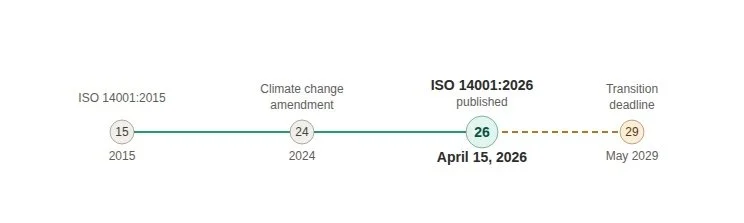
What’s the transition timeline?
The transition period is three years, meaning all certificates issued to ISO 14001:2015 must be transitioned to the 2026 edition before May 2029 to remain valid. That sounds like plenty of runway — until you factor in that certification bodies need time to get accredited to audit against the new standard, and your internal teams need to understand the changes before they can close gaps. Start now.
How do you get a copy?
The official standard is available for purchase directly through iso.org. Search for ISO 14001:2026 — it's live now. If you are located in the US, you’ll want to purchase the standard from ANSI.
ISO also published a free transition brochure — ISO 14001:2026: Your trusted standard, clearer than ever — summarizing the major changes. Worth grabbing as a quick orientation tool for your leadership team.
Our take.
We've been tracking this revision for a couple of years now. The changes align tightly with what we've been building inside the 12 Tools™ Methodology — structured change management, supply chain integration, leadership visibility, and environmental performance as a system outcome rather than a compliance checkbox. We'll be publishing updated resources, gap analysis frameworks, and training through the Concentric Community platform as transition support ramps up.
If you want help understanding where your system stands relative to the 2026 requirements, reach out or join the discussions in the Concentric Community. We're already working with organizations on gap assessments and transition planning.
The standard is out. The clock is ticking. Let's build something worth certifying.
—
James Thompson is Founder & CEO of Concentric Global and an Exemplar Global Certified Master Consultant & Master Auditor. Concentric Global helps organizations build management systems that perform — not just comply.