

Using the 12 Tools Framework for Tackling ISO 13485 Compliance
Many compliance and auditing courses focus on WHAT the standard says. Our courses come with additional layers explaining WHY requirements exist (the intent behind specific compliance obligations) and HOW an organization might want to address the compliance obligation (based on best practices we’ve seen over decades of auditing and implementation in the medical device space).
At the core of best-practice sharing lies a structured set of practical tools often referred to as the “12 Tools.” For learners interested in seeing one example of how organizations operationalize ISO 13485 and risk-based thinking beyond theory, an overview is available at 12tools.com or concentricglobal.co/12tools.
This framework is a comprehensive business operating system built on lean and ISO principles. It’s a business process framework that aligns teams, tracks performance, manages regulatory risk, and simplifies compliance maintenance for medical device manufacturers. The 12 Tools help you map workflow, assign clear roles, control design and production risks, and drive continuous improvement through simple visualization. Whether you’re aiming for ISO 13485 certification, aligning with FDA QSR, MDR/IVDR, or building a robust QMS that protects patients while scaling your business, this methodology gives you the structure you need.
Note: The following mapping is provided for instructional reference purposes. Auditors and practitioners often find it helpful to see how ISO 13485 requirements can be translated into repeatable tools and visual management practices. The full framework and context for these examples can be reviewed at 12tools.com or concentricglobal.co/12tools . For ease of use, this mapping is based on ISO 13485:2016 as the primary reference.
12 TOOLS → ISO 13485 CLAUSE MAPPING
Tool 1 - Interaction of Processes & Ownership (50K Map)
ISO 13485:2016 – Clause 4.1 General requirements (QMS processes, interactions, and regulatory roles)
ISO 13485:2016 – Clause 4.2 Documentation requirements (high-level process overview)
ISO 13485:2016 – Clause 5.5.1 Responsibility and authority
Rationale: Clarifies all key processes that make up the medical device QMS (design, production, post-market, etc.), scope, interactions, and individual ownership using a high-level “50K Map” while explicitly addressing applicable regulatory requirements.
Tool 2 - Goal Tree & Annual Operating Plan (AOP)
ISO 13485:2016 – Clause 5.1 Management commitment
ISO 13485:2016 – Clause 5.4.1 Quality objectives
ISO 13485:2016 – Clause 5.4.2 QMS planning
Rationale: Defines high-level business goals and translates them into measurable annual plans, ensuring leadership accountability and alignment of the QMS with regulatory and patient-safety priorities.
Tool 3 - Applicability Matrices
ISO 13485:2016 – Clause 4.1 General requirements (applicable regulatory requirements)
ISO 13485:2016 – Clause 4.2.1 General (documentation needed for compliance)
ISO 13485:2016 – Clause 5.5.1 Responsibility and authority
Rationale: Easily identify what regulations, standards (MDR, FDA QSR, etc.), and tools apply to each process owner and team member.
Tool 4 - Turtle Diagrams (5K Process Maps)
ISO 13485:2016 – Clause 4.1 General requirements (process interactions and resources)
ISO 13485:2016 – Clause 7.1 Planning of product realization (risk management in processes)
ISO 13485:2016 – Clause 7.3 Design and development (inputs/outputs/controls)
ISO 13485:2016 – Clause 7.5 Production and service provision
Rationale: Zoom in on individual processes with a one-page visual showing inputs, outputs, roles, risks, and controls—perfect for design, manufacturing, and post-market surveillance processes.
Tool 5 - Master Document & Records Matrix
ISO 13485:2016 – Clause 4.2.3 Medical device file
ISO 13485:2016 – Clause 4.2.4 Control of documents
ISO 13485:2016 – Clause 4.2.5 Control of records
Rationale: Maintain audit-ready document and record control across all functions, with quick filtering by process—critical for the medical device file and regulatory traceability.
Tool 6 - Training Tracker & Competency Passport
ISO 13485:2016 – Clause 6.2 Human resources (competence, awareness, training)
ISO 13485:2016 – Clause 7.1 Planning of product realization (personnel for effective processes)
Rationale: Track skills, training status, job roles, and compliance gaps using individual “passports” to ensure personnel are competent for safety-critical medical device activities.
Tool 7 - Process Measures Dashboard (PMD)
ISO 13485:2016 – Clause 8.1 General (monitoring and measurement)
ISO 13485:2016 – Clause 8.2 Monitoring and measurement
ISO 13485:2016 – Clause 8.4 Analysis of data
Rationale: Aggregate process and product metrics in one dashboard so leadership can see performance trends, risk levels, and the need for corrective action in real time.
Tool 8 - Annual Audit Schedule
ISO 13485:2016 – Clause 8.2.2 Internal audit
Rationale: Plan and track internal audits based on risk, process performance, and regulatory changes—ensuring the audit program remains effective and focused on high-impact areas.
Tool 9 - Management Review & Meeting Plans
ISO 13485:2016 – Clause 5.6 Management review
Rationale: Keep leadership aligned with structured reviews of QMS performance, regulatory compliance, risk status, and improvement actions.
Tool 10 - Action Tracker
ISO 13485:2016 – Clause 8.5.1 Corrective action
ISO 13485:2016 – Clause 8.2.3 Reporting to regulatory authorities (when applicable)
ISO 13485:2016 – Clause 8.3 Control of nonconforming product
Rationale: Central repository for all action items (complaints, non-conformities, CAPA, risk controls) with clear accountability and status tracking.
Tool 11 - Risk/Opportunities Assessment & Prioritization
ISO 13485:2016 – Clause 7.1 Planning of product realization (risk management)
ISO 13485:2016 – Clause 8.5 Improvement (preventive and corrective)
Rationale: Proactive risk assessment (patient safety, regulatory, business) using tools like FMEA or SWOT—prioritizes actions throughout the product lifecycle.
Tool 12 - Corrective Action & Continual Improvement
ISO 13485:2016 – Clause 8.5.1 Corrective action
ISO 13485:2016 – Clause 8.5.2 Preventive action (where applicable)
ISO 13485:2016 – Clause 8.1 General (continual improvement of the QMS)
Rationale: Eliminate recurring issues at the root cause and drive ongoing improvement in product safety, regulatory compliance, and business performance.
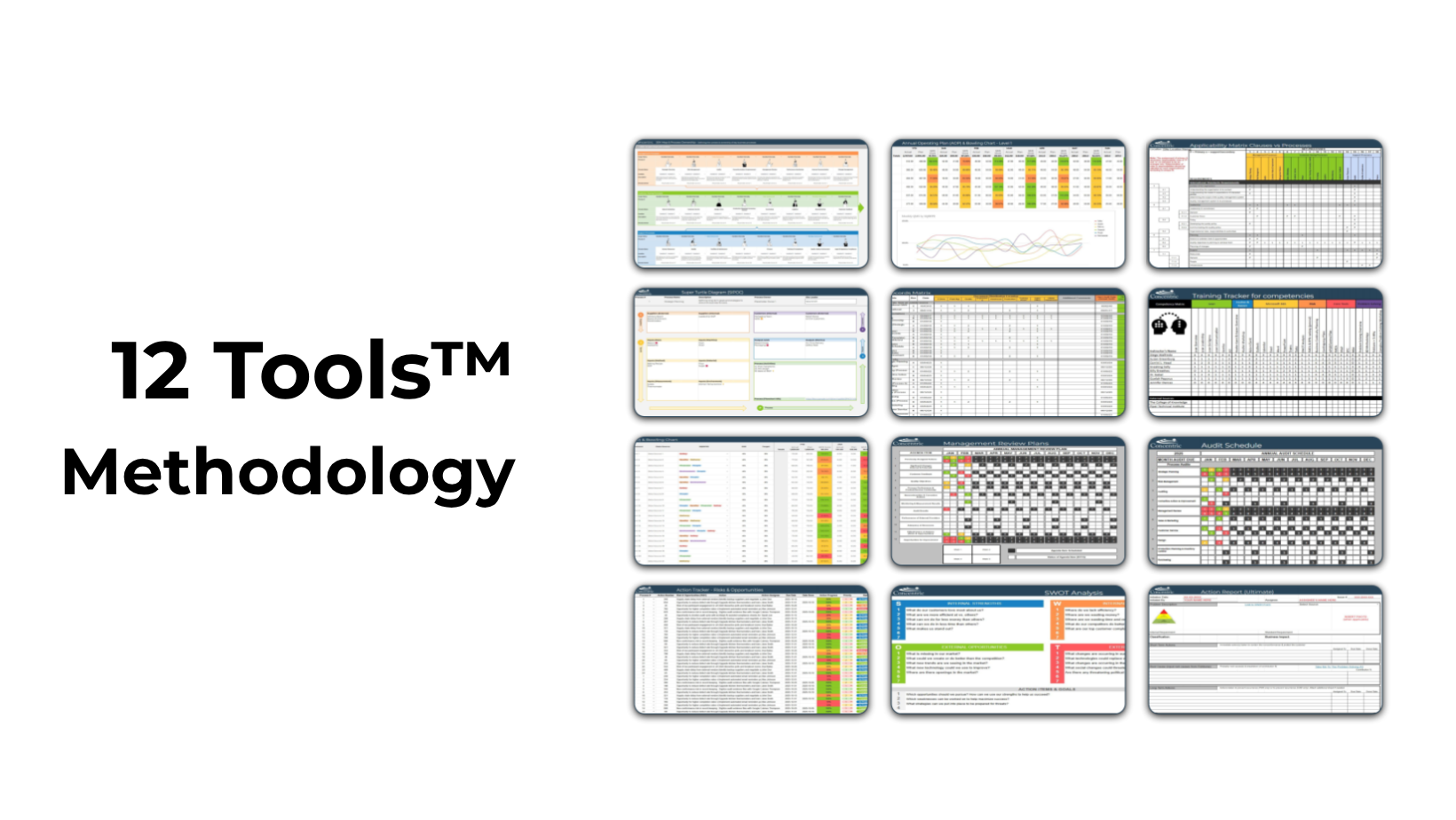
Why the 12 Tools are a game-changer for ISO 13485 organizations
Built-in risk-based thinking across every tool (exactly what regulators want).
Visual, one-page formats that auditors and process owners actually use.
Easy integration with your existing Excel/Google Sheets workflow (see the Turtle Diagram prototype we already built in the project notes PDF).
Scalable from one-person startup to multi-site manufacturer.
Ready to put these tools to work?
✅ Download the 12 Tools here
✅ Book a gap-analysis workshop
✅ Join the Concentric Academy for step-by-step implementation training