Pain Point 1 – Lack of Defining the Organization and Process Ownership
It all begins with an idea. Maybe Many organizations operate without a clear, shared understanding of how work actually flows across the business. Processes evolve organically, responsibilities shift over time, and interdependencies are assumed rather than documented. The result is a system where ownership is unclear and accountability is diffused—felt daily by leaders, process owners, and auditors alike.
Why this matters
Without a complete, high-level view of the organization—including process scope, interactions, and ownership—teams operate in silos. Work is duplicated, critical handoffs are missed, and gaps remain hidden until something fails. From a compliance perspective, this often surfaces during audits as unclear scope, inconsistent process boundaries, or ownership disputes. From a business perspective, it translates into wasted effort, slower decision-making, increased risk, and missed opportunities to scale effectively.
The better way
A simple, scalable system-level map that defines what the organization does, how processes interact, and who owns them. With a clear 50,000-foot view:
Accountability becomes explicit
Cross-functional collaboration improves
Audit scope and system boundaries are immediately clear
The management system can grow and adapt without being rebuilt
This clarity becomes the foundation for every other improvement, control, and performance conversation.
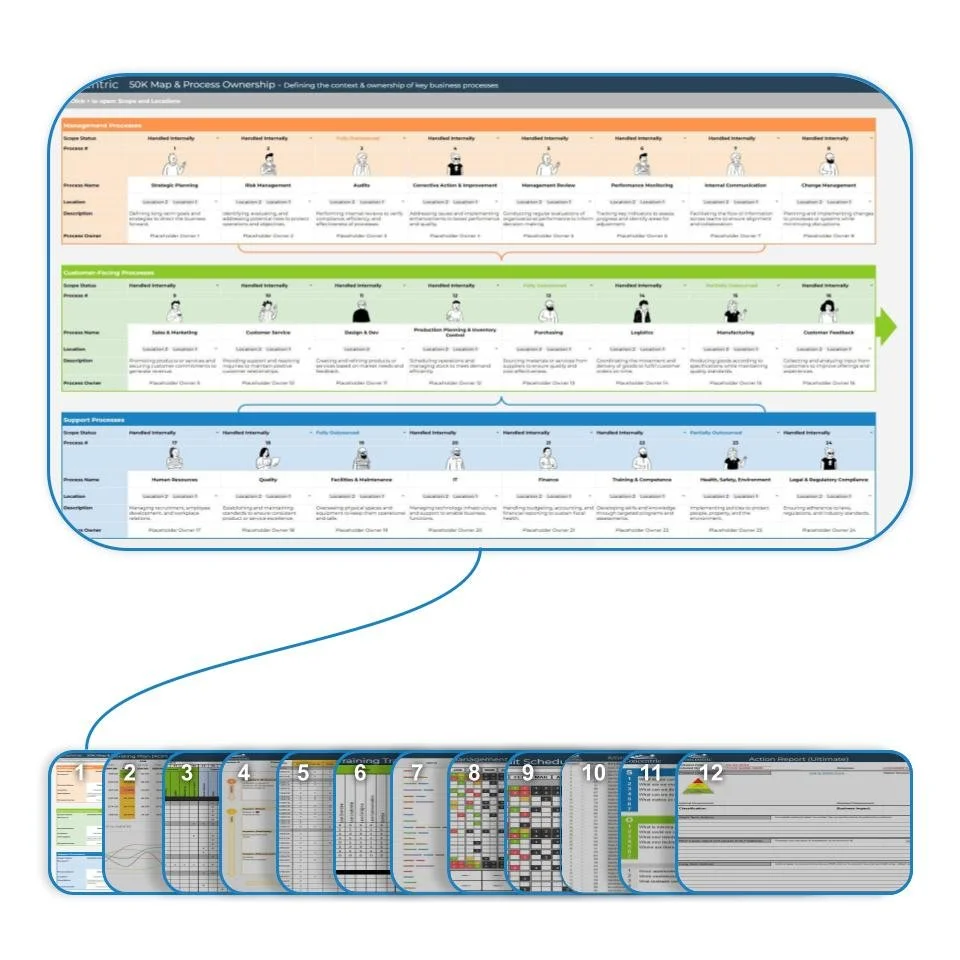
Tool 1: 50K Map of Processes & Ownership
The 50K Map of Processes & Ownership is the foundational tool of the 12 Tools™ Methodology. It provides a single, high-level view of the organization’s process architecture—clearly defining process scope, interdependencies, and ownership in one place.
Built in a dynamic, spreadsheet-based format, the tool combines clarity, structure, and flexibility. It is designed to be easily maintained, linked to downstream tools, and updated as the organization evolves. Developed and refined through more than 15 years of real-world use, it scales seamlessly from small organizations to complex, multi-site systems and serves as the backbone of the entire management system.
This tool does not replace visual process mapping—it anchors it. Everything else connects here.
How Tool 1 Fits into the 12 Tools™ System
The 50K Map is not an endpoint—it is the starting point. It defines the system that all other tools build upon, from applicability and process mapping to audits, metrics, and management review. Without it, the rest of the system lacks cohesion.
Explore the tool, contribute your perspective, and share how your organization defines ownership and scope. This system continues to evolve through real practitioner input—yours included.
Other Commonly Used Tools (and Their Limitations)
Lucidchart
A collaborative diagramming platform well-suited for visualizing processes quickly.
Strength: Intuitive and accessible.
Limitation: Lacks structured ownership and system-level compliance focus.Microsoft Visio
A powerful tool for detailed process modeling and data-linked diagrams.
Strength: Robust and enterprise-capable.
Limitation: Often overly complex for maintaining a high-level organizational view.Draw.io (diagrams.net)
A free, browser-based tool for flowcharts and simple diagrams.
Strength: Easy to start and cost-effective.
Limitation: Limited structure, automation, and system integration.Miro
An open, visual workspace for brainstorming and mapping relationships.
Strength: Excellent for workshops and ideation.
Limitation: Not designed for formal process ownership or compliance systems.