
Pain Point 8 – Ineffective Leadership Reviews Due to Lack of Structure
Many organizations hold management reviews, but without a consistent agenda or defined outputs, those meetings often become unfocused discussions. Topics vary from meeting to meeting, data is reviewed inconsistently, and important inputs—such as audit results, performance trends, or risks—are overlooked or rushed.
Why this matters
When management reviews lack structure, leadership cannot reliably assess the effectiveness of the management system. Required inputs and outputs are missed, decisions are not clearly documented, and actions are inconsistently defined. From a compliance perspective, this frequently results in nonconformities against requirements such as ISO 9001 Clause 9.3. From a business perspective, it leads to wasted meeting time, unclear direction, stalled improvement efforts, and accountability gaps at the leadership level.
The better way
A consistent, repeatable management review structure that ensures the right topics are covered every time—and that decisions are clearly captured. With a structured agenda and standardized minutes:
Leadership reviews remain focused and efficient
Required inputs (metrics, audits, risks, objectives) are consistently addressed
Outputs such as decisions, priorities, and actions are clearly documented
Reviews drive alignment and improvement rather than discussion alone
This transforms management review from a compliance obligation into a leadership tool.
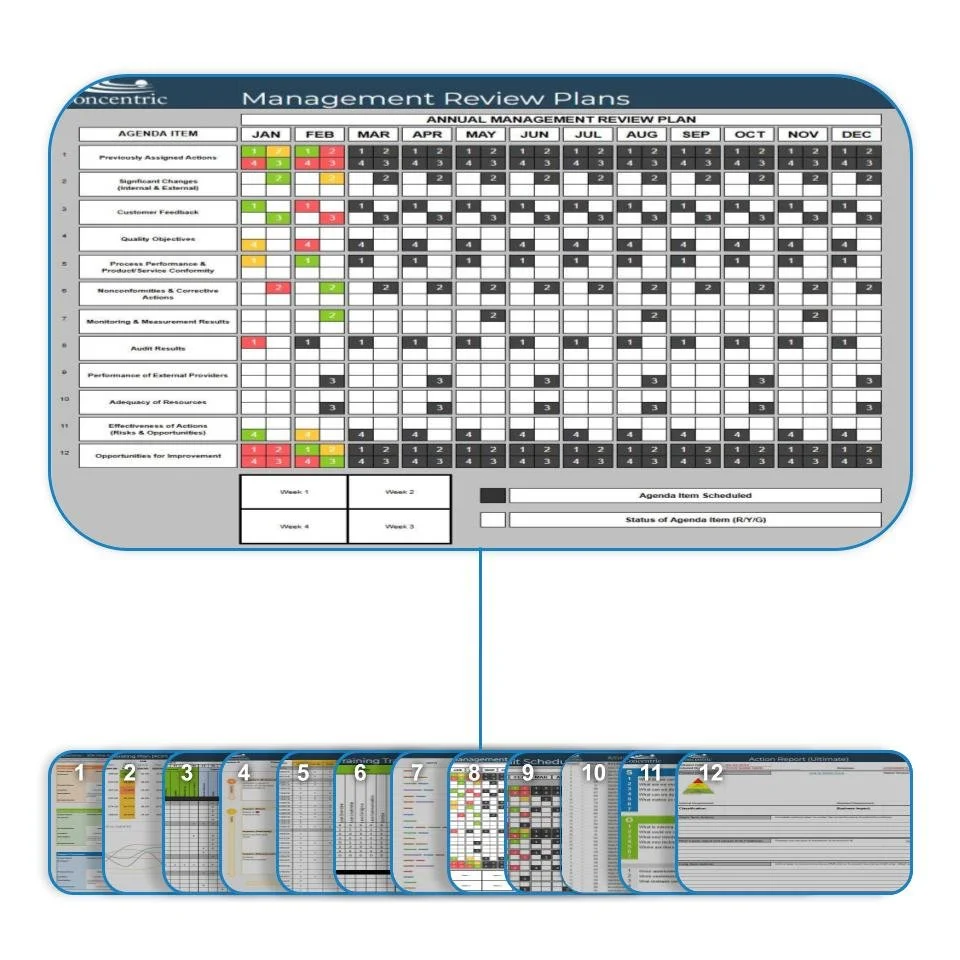
Tool 8: Management Review Agenda & Minutes Template
The Management Review Agenda & Minutes Template provides a clear, ISO-aligned structure for planning and documenting management reviews. It ensures that required inputs are systematically reviewed and that outcomes—decisions, priorities, and action items—are clearly recorded.
Built in a flexible, document-based format, the tool supports pre-populated agenda sections linked to performance data, audits, risks, and objectives. It also provides structured space for capturing conclusions and next steps, creating a consistent record of leadership oversight. Refined through more than 15 years of real-world application, the template balances discipline with practicality—making reviews both efficient and effective.
This tool ensures leadership conversations lead to clarity, not ambiguity.
How Tool 8 Fits into the 12 Tools™ System

The Management Review Agenda & Minutes Template brings together inputs from across the system—performance metrics (Tool 7), audits (Tool 6), risks (Tool 11), and objectives (Tool 2)—into a single leadership forum. It creates the structure required for effective oversight, while Tool 10 ensures that resulting actions are executed and tracked.
Apply the template to your next management review, tailor it to your organization’s scope, and keep it consistent. Share your agenda refinements and lessons learned in the forum below—practitioner input continues to strengthen the system.
Other Commonly Used Tools (and Their Limitations)
ISMS.online
A compliance-focused platform with management review workflows and reminders.
Strength: Strong traceability to ISO requirements.
Limitation: Heavily oriented toward information security systems.Qualio
A quality management platform offering review templates and electronic approvals.
Strength: Streamlined documentation and sign-off.
Limitation: More prescriptive and industry-specific.Hyperproof
A compliance management platform with real-time reporting for leadership reviews.
Strength: Data-driven insights across compliance domains.
Limitation: Broader scope may add complexity for quality-focused systems.Sprinto
An automation-focused compliance tool supporting review workflows and evidence tracking.
Strength: Accelerates audit preparation.
Limitation: Primarily geared toward SOC 2 and security-driven frameworks.