
Pain Point 5 – Document and Record Management Chaos
As organizations grow, documents and records multiply quickly. Procedures, forms, records, and evidence are stored in multiple locations, maintained by different owners, and updated at different times. Over time, it becomes increasingly difficult to know which version is current, where records reside, and how long information must be retained.
Why this matters
When document and record control is weak, outdated instructions are unintentionally used, critical records cannot be retrieved during audits, and compliance risks increase. From an ISO perspective, this frequently appears as nonconformities against requirements such as ISO 9001 Clause 7.5—missing records, uncontrolled documents, or unclear retention practices. From a business standpoint, the impact includes wasted time searching for information, inconsistent execution, legal exposure, and growing frustration across teams.
The better way
A single, structured view of all documents and records that matter to the management system. By clearly defining:
What documents and records exist
Where they are stored
Who owns and maintains them
Revision status and retention requirements
organizations gain immediate visibility and control. Audits become faster and more predictable, teams trust the information they use, and the system scales without becoming unmanageable.
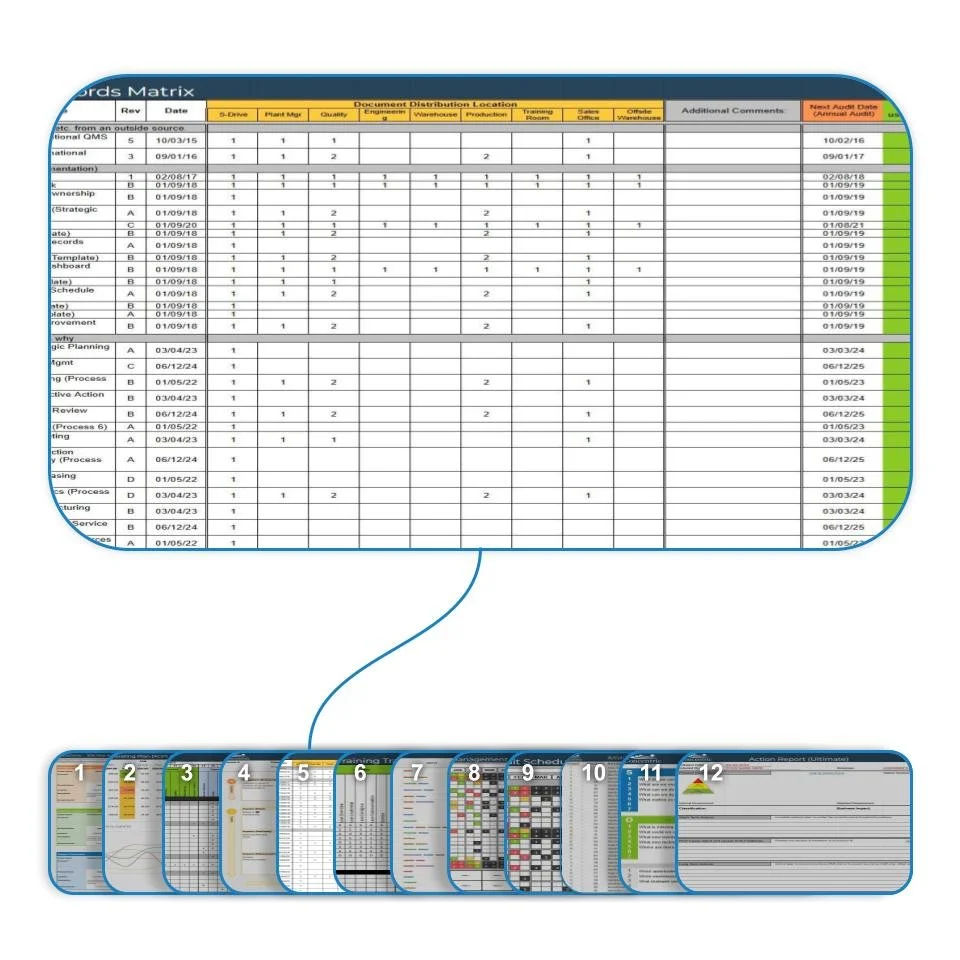
Tool 5: Master Document & Records Matrix
The Master Document & Records Matrix provides a centralized, system-level inventory of all controlled documents and required records. Using a clear, grid-based format, it captures ownership, storage location, revision status, and retention requirements in one place—creating a single source of truth for document control.
Built in a flexible, spreadsheet-based environment, the tool supports automation, filtering, and easy updates as documents change or new requirements are introduced. It integrates directly with process maps, training requirements, audits, and corrective actions. Refined through more than 15 years of real-world use, it enables organizations to maintain audit readiness without excessive administrative burden.
This tool turns document control from a recurring problem into a stable foundation.
How Tool 5 Fits into the 12 Tools™ System

The Master Document & Records Matrix supports every other tool in the system. It links process definitions (Tool 4), training requirements (Tool 6), audits (Tool 8), and corrective actions (Tool 12) to controlled information and evidence. Without reliable document and record control, consistency and compliance cannot be sustained.
Apply the matrix to your existing document set, validate ownership and retention, and keep it current as the system evolves. Practitioner feedback continues to inform how this tool is refined and improved.
Other Commonly Used Tools (and Their Limitations)
MasterControl
An ISO-focused quality management platform with advanced document routing and audit trails.
Strength: Strong compliance reporting and traceability.
Limitation: Higher cost and system overhead for advanced functionality.Qualio
A QMS platform that supports document matrices, approvals, and collaboration.
Strength: Streamlined workflows and electronic signatures.
Limitation: More tailored to specific regulated industries.QT9 QMS
A cost-effective solution for document control and ISO workflows.
Strength: User-friendly for manufacturing environments.
Limitation: Less flexible for non-manufacturing or multi-standard systems.M-Files
A metadata-driven document management system with advanced search capabilities.
Strength: Powerful classification and retrieval features.
Limitation: Steeper setup and configuration effort.